
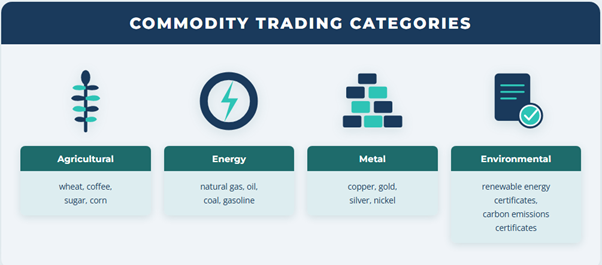
When you trade commodities you have a wide variety of assets at your disposal – from raw materials and agricultural products to energy resources and metals. Generally, commodities can be divided into four main categories:
Commodity trading involves speculating or hedging on the price movements of raw materials such as oil, gold, or wheat. Traders do this using financial derivatives like options or contracts for difference (CFDs).
When trading commodities via derivatives, you can take positions based on either the spot price (the current market price for immediate settlement) or a futures price (the current market price for settlement at a future date).
Spot pricing is often used for short-term trading, with tighter spreads and no expiry. Futures-based pricing is popular for hedging or trading around key contract dates, as it reflects broader market expectations over time.
When you trade futures with us, you’ll see the commodity listed with its expiry date, meaning you’re locking in today’s price for settlement on that future date. Meanwhile, for spot markets we don’t show this date, meaning you’re trading for immediate settlement.

Traders might open a buy position when anticipating the price of a commodity to rise, or a sell position if they expect it to fall. For example, a trader could short natural gas ahead of a mild winter, anticipating lower demand and falling prices.
Commodity prices are influenced by supply and demand, weather events, geopolitical factors such as conflict or trade policy, production output, and macroeconomic data. These factors can lead to sharp price movements and high volatility.
Traders may speculate on short-term price movements or hedge existing exposure. For example, a coffee producer might hedge against falling prices, while a retail trader might speculate on gold as a safe-haven asset.
With an online brokerage account, retail traders can access global markets – such as CME Group or ICE – and trade a range of assets electronically, often with flexible position sizes.
Let’s say you decide to trade gold CFDs. The current market price for gold is $2,000 per ounce.
After conducting some fundamental analysis, you believe the price of gold will rise. You open a long CFD position equivalent to 20 ounces of gold. With a margin requirement of just 5%, you’d only need to put down $2,000 (5% of the total exposure: 20 ounces × $2,000 = $40,000).
Over the next day, gold’s price increases by $20 per ounce to $2,020, and you close your position.
You’ve made a profit of $400 ($20 increase × 20 ounces), minus any overnight funding charges if applicable.
However, if the price of gold decreases by $20 per ounce to $1,980, you would incur a loss of $400 ($20 decrease × 20 ounces), plus any applicable overnight funding charges.
Commodities trading primarily takes place on global exchanges and in over-the-counter (OTC) markets. Retail traders can access these markets through trading platforms provided by regulated online brokerages, where they can speculate on commodity prices via derivatives, such as CFDs or futures, without owning the underlying assets.
The largest and most influential commodity exchanges globally include:
Retail traders typically access these exchanges through regulated brokers who offer platforms featuring live price charts, flexible position sizes, and leverage options.
Commodity trading operates nearly 24 hours a day, five days a week, across various global exchanges. Unlike stock markets with fixed schedules, commodity markets offer extended trading periods to accommodate participants worldwide.
Here are the trading hours for key commodities markets in coordinated universal time (UTC)*:
Exchange | Summer hours | Winter hours |
CME Globex | Sunday 10pm – Friday 9pm (break 9-10pm) | Sunday 11pm – Friday 10pm (break 10-11pm) |
ICE Futures | Monday 12am – Friday 10pm (break 9:05 pm – 10:25pm) | Monday 1am – Friday 11pm (break 10:05 pm – 11:25pm) |
LMEselect | Monday 12am – Friday 6pm | Monday 1am – Friday 7pm |
Commodities trading hours vary for each commodity.
For weekend trading hours, visit our comprehensive weekend trading hours page.
*These schedules are subject to change due to factors such as public holidays and exchange-specific maintenance periods.
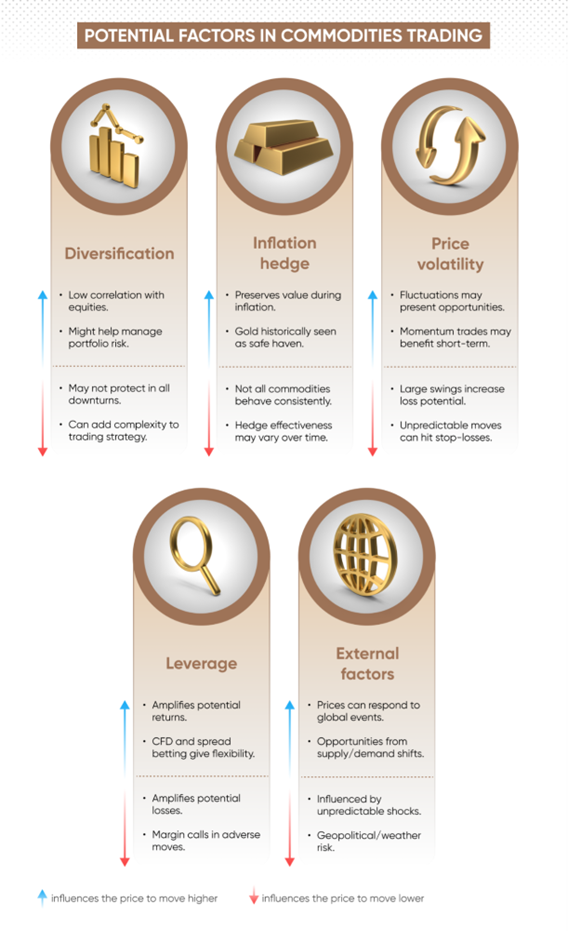
Commodity trading carries both potential benefits and inherent risks, due to various factors, including price volatility and commodity-specific conditions.
Commodities may offer portfolio diversification, as they have historically shown a low correlation with traditional assets like stocks and bonds. However, in broad market sell-offs or during systemic shocks, correlations can increase, reducing diversification benefits.
Commodities such as gold have historically acted as a hedge against inflation, potentially preserving purchasing power. However, not all commodities behave consistently during inflationary periods, and their effectiveness as a hedge can vary.
Frequent price swings can create short-term trading opportunities, particularly for active traders using technical strategies. At the same time, sharp and unpredictable price movements can lead to significant losses, especially in leveraged positions.
Trading commodities via CFDs allows exposure with relatively small upfront capital, increasing potential returns. However, leverage can also amplify potential losses, trigger margin calls or force position closures.
Commodity prices are influenced by global events such as supply disruptions, weather, and geopolitical developments, often leading to substantial price moves and increased uncertainty. While these factors can present trading opportunities, they also make markets more difficult to predict.
Commodities traders can use a range of strategies, using a combination of technical and fundamental analysis, to help identify and confirm potential trends with effective risk management.
Scalping is a short-term trading strategy where traders execute multiple trades daily, aiming for small profits from minor price fluctuations. Scalpers typically hold positions for minutes or even seconds, relying heavily on technical indicators, price action, and real-time market data.
Trend trading involves identifying and trading in the direction of an established market trend. Trend traders typically use technical indicators such as moving averages and other tools to confirm the strength and direction of the trend before opening a long (buy) or short (sell) position.
Swing trading targets short to medium-term price movements. Swing traders might hold positions from a few days up to several weeks – using both fundamental and technical analysis to calculate potential entry and exit points based on broader market trends.
Day traders open and close positions within the same trading day, contrasting with swing traders who may hold trades for days or weeks. They might aim to capture gains from short-term price volatility, frequently using technical analysis tools such as volume indicators to inform trading decisions.